
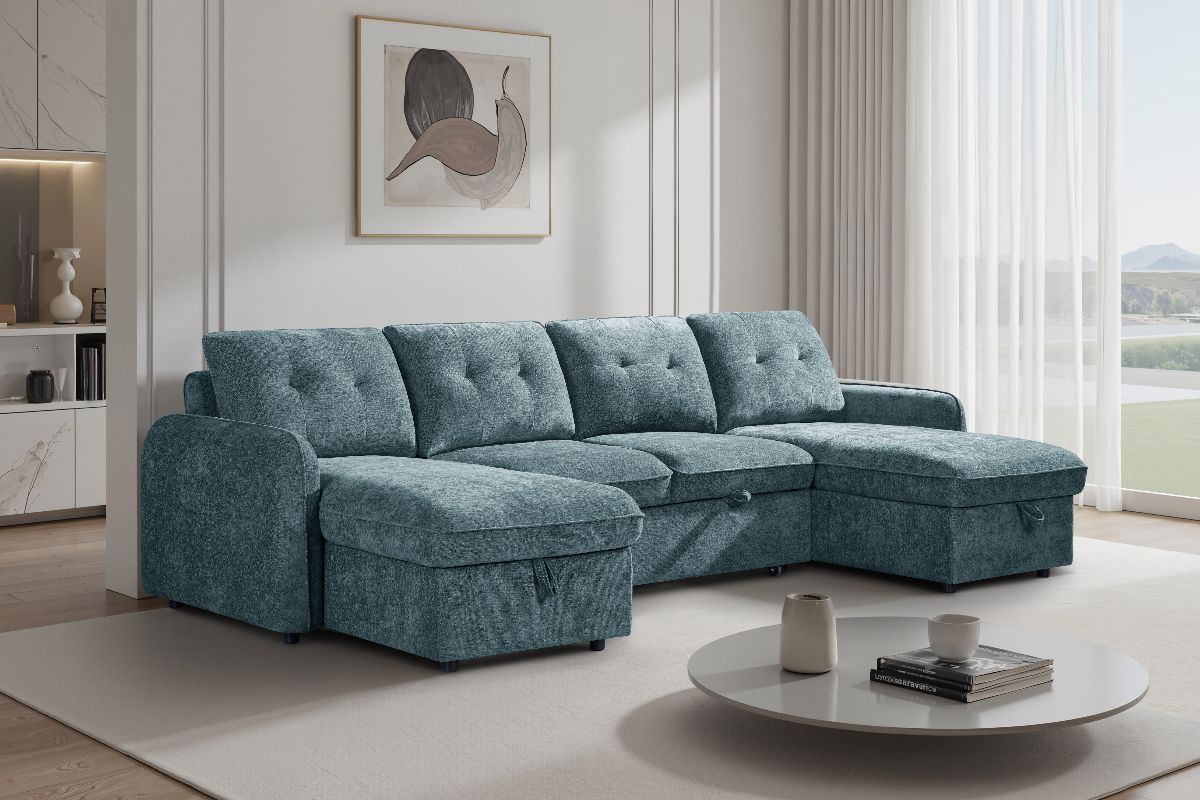
The corner sofa is the most popular sofa type in the UK — and it's not difficult to see why. It makes better use of wall space than a standard sofa, seats more people per square metre, and creates a defined, considered seating zone that a standalone sofa rarely achieves on its own. But "corner sofa" covers a lot of ground. An L-shaped corner sofa and a U-shaped sofa bed are both technically corner sofas, but they suit entirely different rooms, households, and priorities.
This guide breaks down every significant corner sofa type — what it is, who it suits, what makes it different, and what to watch for when choosing. By the end, you should know which configuration belongs in your room rather than simply knowing that several configurations exist.
What Is a Corner Sofa?
Before getting into the types, it's worth being precise about what a corner sofa actually is. A corner sofa is any sofa with an angled section — a chaise, arm extension, or additional seating module — that allows it to wrap around a corner or run along two walls at an angle. The term covers everything from a simple L-shape with a chaise on one side to a full U-shape with seating on three sides.
What all corner sofas share is the fundamental space advantage: by utilising a corner rather than simply sitting against a single wall, they increase seating capacity without increasing the overall footprint proportionately. This is why a corner sofa often works in rooms where you might assume it won't — including, counterintuitively, smaller rooms. (If that's your situation, our guide to corner sofas in small living rooms covers the sizing and placement decisions in more detail.)
The Main Types of Corner Sofa
1. The L-Shape Corner Sofa
The L-shape is the most common corner sofa configuration and the one most people picture when they hear "corner sofa." It consists of a main seating section with an extended chaise or shorter arm on one side, forming the characteristic L. One arm is longer than the other — typically by a significant margin — and the sofa is designed to sit with the longer arm along one wall and the shorter along the adjacent wall.
Who it suits: Almost everyone. The L-shape works in small-to-large living rooms, suits single households and families alike, and comes in more configurations, fabrics, and price points than any other corner sofa type. It's the default choice for good reason — versatile without being as space-demanding as a U-shape.
Left-hand vs right-hand facing: This is the detail most people overlook, and it's the most consequential decision in the L-shape purchase. Left-hand facing means the chaise (the longer arm) falls to your left when you're seated and facing the sofa. Right-hand facing puts it to your right. The correct orientation is determined entirely by your room layout — where your door is, where your screen is, and which wall the longer arm should run along. Getting this wrong is one of the most common and easily avoided sofa-buying mistakes.
Universal corner sofas offer a middle path — they're designed to work in either orientation, which is particularly useful if you're not certain of your layout or plan to move. The trade-off is occasionally a slightly less tailored fit to either wall.
Back style matters here too. An L-shape sofa with a scatterback feels informal and relaxed — well-suited to family rooms and open-plan spaces where comfort is the priority. A fullback or cushion-back L-shape reads as cleaner and more structured, suiting rooms where a tidier aesthetic matters.
Browse the full L-shape corner sofas collection, or narrow by colour: grey, beige, black, or cream.
2. The Large Corner Sofa
Technically a subset of the L-shape, the large corner sofa deserves its own consideration because the scale creates genuinely different requirements. Where a standard L-shape might run 220cm along the longer arm, a large corner sofa extends to 260cm, 290cm, or beyond — changing the room planning entirely and creating a much more dominant presence.
Who it suits: Larger living rooms, open-plan spaces, and households where seating capacity is a priority. A large corner sofa seats five or more comfortably and creates an unmistakable centrepiece in any room it occupies. In an open-plan kitchen-diner, a large corner sofa is one of the most effective ways to define the living zone without walls doing the work.
What to be careful about: Scale. A large corner sofa that's too big for a room doesn't just look wrong — it makes the room feel blocked and difficult to move through. Allow at least 70–80cm of walkway clearance on the open sides, and measure with the sofa fully positioned in your mind before ordering. See our large corner sofas collection for the full range at this scale.
3. The U-Shape Sofa
A U-shape sofa wraps around three sides rather than two, creating the distinctive horseshoe layout that maximises seating and creates the most enclosed, sociable arrangement of any sofa configuration. The open end of the U typically faces the screen or the focal point of the room.
Who it suits: Larger rooms, families who need maximum seating, and anyone building a dedicated media room or living space where the sofa is the unambiguous centrepiece. U-shape sofas typically seat six to seven people and require rooms of at least 4m x 4m to sit comfortably with adequate walkway clearance.
The key difference from a corner sofa: A corner sofa (L-shape) has one longer arm and one shorter arm — it occupies two walls. A U-shape occupies three sides of a square, which means it takes significantly more floor space but creates a much more immersive, enclosed seating arrangement. The U-shape is also the most effective configuration for a cinema-style setup, as the wraparound seating naturally orients everyone toward the open end of the sofa — wherever your screen sits.
If you're considering a U-shape for a smaller room where the full configuration won't fit: an L-shape corner sofa with a longer arm on both sides (sometimes called a "wide corner" or "large corner") can achieve a similar feel with a more manageable footprint. See the full U-shape sofas collection alongside the large corner sofas range to compare dimensions side by side.
4. The Corner Sofa Bed
A corner sofa bed combines the L-shape layout with a fold-out sleeping surface — typically concealed within the chaise section or the main sofa body. When closed, it looks and functions exactly like a standard corner sofa. When opened, it reveals a double sleeping surface that makes it one of the most genuinely useful pieces of furniture available.
Who it suits: Anyone who needs occasional or regular guest sleeping without dedicating a room to it. A corner sofa bed in a main living room solves the guest bed problem without a spare room, and it does so without the room ever announcing itself as a guest space. The sofa performs its primary job — seating — on every day except the ones when the bed is needed.
Choosing well: The mechanism and mattress quality matter enormously on a corner sofa bed. A thin mattress (under 8cm) will feel noticeably inadequate for overnight sleeping. Look for 10cm or deeper as a minimum, and a fold-out mechanism that operates smoothly without requiring two people. The chaise section of a corner sofa bed typically houses the sleeping surface — check the open dimensions carefully, as the bed will extend into the floor space in front of the sofa when fully open.
Corner sofa beds with storage are also available — the chaise often conceals both the sleeping surface and a storage compartment, which makes them particularly efficient for rooms that need to be multifunctional. Browse our sofa beds collection filtered for corner configurations.
5. The U-Shape Sofa Bed
A step up from the corner sofa bed in both scale and functionality, the U-shape sofa bed combines the wraparound seating of a full U-shape with a fold-out sleeping surface. It's the most generous dual-function sofa available and suits open-plan spaces or larger living rooms where guests might need to sleep and the room needs to handle that gracefully.
Who it suits: Larger households, frequent entertainers, and anyone building a room that genuinely needs to serve multiple functions simultaneously. A U-shape sofa bed is a significant purchase — it requires the space to justify the U-shape configuration and the commitment to quality to justify the sofa bed element — but when both are right, it's one of the most versatile pieces of furniture you can own.
6. The Recliner Corner Sofa
Some corner sofas incorporate reclining mechanisms — either manual levers or electric motors — into individual seats within the L-shape or larger configuration. The result is a corner sofa that also allows occupants to recline to various positions, extending a footrest and tilting the backrest without leaving the sofa.
Who it suits: Households where extended comfortable sitting is a priority — those who watch long films, read for extended periods, or simply find standard sofas insufficiently comfortable over time. Electric recliner corner sofas are particularly effective in media rooms, as they allow position adjustment without physical effort and without disturbing anyone else's viewing.
The trade-off: Recliner mechanisms add depth to the sofa's footprint when activated — typically 30–50cm behind the backrest. Always check the open dimensions and confirm your room allows adequate clearance before ordering. A recliner corner sofa positioned flush against a wall can't recline without scratching the wall or straining the mechanism.
How to Choose Between Corner Sofa Types: A Decision Framework
With the configurations mapped out, the choice comes down to three questions asked in the right order:
1. What are your room dimensions? Measure both walls before anything else. This eliminates configurations that won't fit and gives you a realistic range of sizes to consider. For rooms under 3.5m x 3.5m, stick to a standard L-shape. For rooms of 4m x 4m or larger, a U-shape or large corner becomes viable. For anything in between, a well-chosen large L-shape is almost always the right answer.
2. What does the room need to do? If it's purely a living room — seating and socialising — any configuration works and the choice comes down to scale and preference. If the room also needs to accommodate guests sleeping, a corner sofa bed is worth prioritising. If the room is a dedicated media space, a U-shape or recliner configuration earns its place. If the room is small and needs to feel spacious, our guide to corner sofas in small living rooms covers the placement and colour decisions that make the most difference.
3. How many people need to be seated? A standard L-shape seats four to five comfortably. A large corner seats five or more. A U-shape seats six to seven. If you regularly have more people than your sofa can seat, scaling up the configuration is worth considering. If you rarely have more than three or four, an oversized sofa will feel disproportionate to the room and to the household.
Choosing Your Colour
Once configuration is settled, colour is the next most significant decision — and with corner sofas it matters particularly because the sheer surface area of the piece means its colour dominates the room more than a smaller sofa would.
- Grey corner sofas — the most popular choice; versatile, practical, and consistently on trend
- Beige corner sofas — warm, grounding, and ideal for rooms with natural wood tones or earthy palettes
- Black corner sofas — confident and contemporary; works across bold and minimal schemes
- Cream corner sofas — the brightest neutral; at its best in well-lit rooms with a considered interior scheme
What About Companion Pieces?
A corner sofa, particularly a well-chosen one, tends to become the room's primary seating arrangement rather than one piece among several. But there are situations where a companion armchair adds something the sofa alone can't — an additional viewing angle, a separate seating zone within a larger room, or a visual counterpoint that stops the arrangement looking like all sofa and nothing else.
When choosing a companion armchair, match tone rather than colour exactly. A slightly darker or lighter shade of the same neutral, or a contrasting colour in a complementary tone, creates a composed arrangement that looks deliberate. An exact colour match tends to look like a set rather than a considered room.
Ready to Browse?
The full corner sofas collection covers every configuration discussed here, with filters for size, colour, back style, and configuration to help you narrow quickly. Our best sellers are a useful starting point if you want to see which models our customers choose with the most confidence — the range's most popular pieces have earned that status for practical reasons.
Every Airedale Living corner sofa is built on a hardwood frame with high-resilience foam seating and premium upholstery — and comes with free UK delivery, in-room assembly, a 5-year frame guarantee, and free returns as standard.
Share:
Corner Sofa in a Small Living Room: Styling Guide
The Best Corner Sofas for 2026: How to Choose the Right One for Your Room