
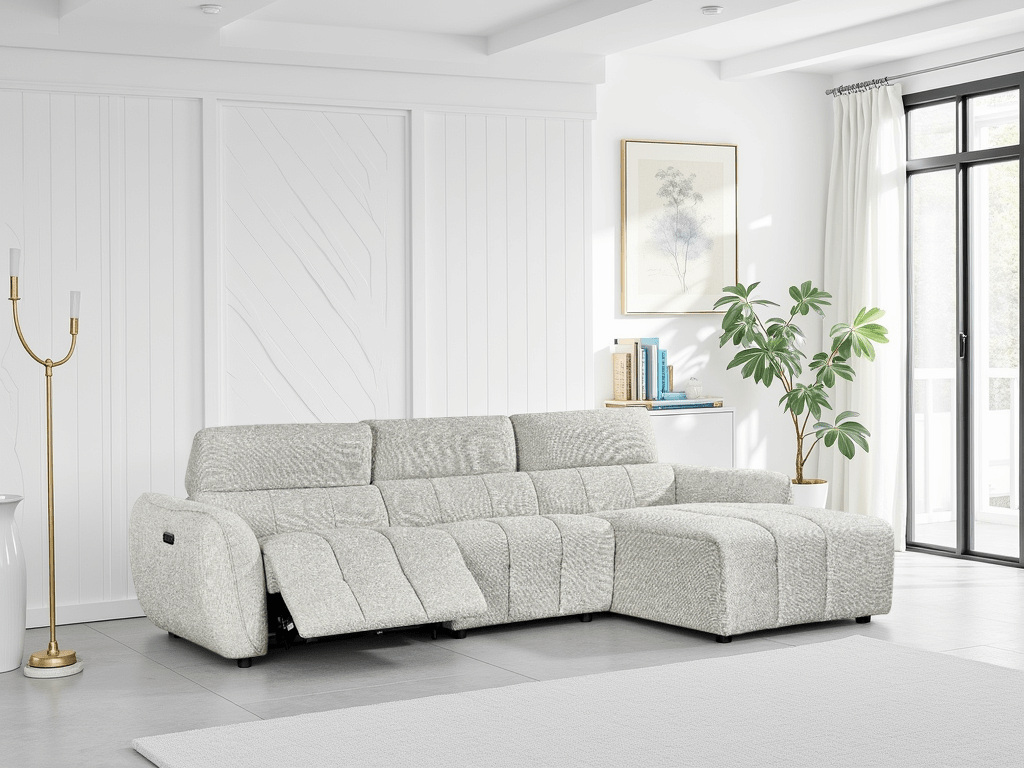
The most effective way to make a recliner sofa look good is to treat it exactly as you would any other sofa — choosing a clean-lined model in quality fabric, placing it deliberately in the room, and styling around it with considered accessories. The assumption that recliners always look bulky or dated is based on a specific style of recliner that no longer represents the category as a whole.
This guide covers everything: room layout, coffee table placement, what to put behind a recliner, how to arrange it with other seating, and how to cover one if the style isn't working.
Do Recliner Sofas Have to Look Bulky?
No - and this is worth addressing directly before anything else.
The recliner sofas that look bulky and dated are almost always a specific type: oversized, high-backed, with prominent external footrests, synthetic leather finishes, and visible mechanism components. These still exist and are sold widely at budget price points — they're the reason the stigma persists.
Contemporary recliner sofas are an entirely different proposition. Low-profile designs, slim track arms, quality upholstery in fabric or premium faux leather, and completely concealed mechanisms mean a modern recliner is virtually indistinguishable from a standard sofa when not in use. The reclining function is invisible until activated — which is exactly what good design should achieve.
The styling advice in this guide assumes a contemporary recliner design. If you're working with an older or bulkier model, the cover and slipcover section at the end addresses how to improve its appearance without replacement.
Room Layout: How to Position a Recliner Sofa
Positioning a recliner sofa well is the foundation of making it look good — get this right and the styling decisions that follow become significantly easier.
Establish Wall Clearance First
Standard recliners need 30–45cm of clearance behind the sofa to tilt fully. This isn't optional — positioning without adequate clearance prevents recline and can damage the mechanism. Wall-hugger models need as little as 5–10cm, making them the practical choice for tighter rooms.
Before any styling decisions, confirm your clearance and mark the sofa's final position on the floor. Everything else — the coffee table, the rug, the other seating — is planned around this fixed point. For full guidance on positioning, read how to position a corner sofa in your living room — the layout principles apply equally to recliner sofas.
Face the Focal Point
The recliner should face the room's focal point — TV, fireplace, or window — directly. The reclined position is designed for TV watching and resting, so the sightline matters more than it does with a standard sofa. If the sofa is angled away from the TV, the reclined position will feel uncomfortable regardless of how good everything else looks.
Float It If the Room Allows
In larger rooms and open-plan spaces, floating the recliner away from the wall — rather than pushing it against it — creates a more considered, designed look. A sofa table or narrow console table placed directly behind the floating sofa fills the gap visually, provides a surface for lamps and décor, and defines the back of the seating area. This also gives you the required recliner clearance without an awkward empty gap between sofa and wall.
What to Put Behind a Reclining Sofa
The gap required behind a standard recliner is one of the most common styling frustrations — it can make the sofa look disconnected from the room if not addressed.
A narrow console table: The most popular and effective solution. Position the table at exactly the required clearance distance — typically 35–45cm behind the sofa back — and style it with a lamp, books, and a plant or two. This fills the visual gap, adds function, and makes the room look deliberately designed rather than constrained by a clearance requirement.
A low sideboard: A slightly deeper piece than a console table, positioned at the clearance distance. This works particularly well if you need storage behind the sofa — the sideboard becomes a functional room divider in open-plan spaces.
A row of plants: For a softer, more organic approach — a line of taller houseplants positioned at the clearance point softens the gap without adding furniture bulk. Works especially well with grey corner sofas or neutral fabric recliners where you want warmth and texture without competing colour.
Can you put a sofa table behind a reclining sofa? Yes — provided the table is positioned at or beyond the clearance distance the mechanism needs to tilt. Never position a sofa table so close that the backrest contacts it during recline.
Coffee Table Placement With a Recliner Sofa
Can you have a coffee table with a reclining sofa? Yes — but placement requires more planning than with a standard sofa, because the footrest extends outward when activated.
How Far Does the Footrest Extend?
Most recliner footrests extend 40–60cm beyond the front edge of the sofa when fully open. This means a coffee table positioned at the standard 45cm clearance from a standard sofa will be too close for a recliner — the extended footrest will either hit the table or prevent full extension.
Recommended Coffee Table Distance
Position the coffee table 70–90cm from the front edge of the recliner sofa — further than you would for a standard sofa. This gives the footrest room to extend fully while keeping the table within comfortable reach when seated upright.
What Type of Coffee Table Works Best?
Round or oval tables are the safest choice with a recliner sofa. The curved edges eliminate sharp corners at footrest height, and the shape looks proportionate alongside the softer silhouette of a recliner.
Low tables (40–45cm height) work better than standard height tables — at footrest height, a lower table is less obstructive and visually lighter in the room.
Nesting tables are an excellent practical solution — they can be pulled close when needed and pushed back to give the footrest full clearance when reclining. This eliminates the need to position the main table at maximum recliner distance permanently.
Glass or acrylic tables — visually lightweight and transparent, these are particularly effective with larger or more substantial recliner sofas where you want to reduce visual clutter around the piece.
How to Decorate a Recliner Sofa With Cushions
Cushions are the most immediate and impactful way to elevate the appearance of a recliner sofa — and the principles are identical to any other sofa.
Use two to three cushion sizes in combination — a large cushion (60x60cm) at the back of each seat, a medium cushion (50x50cm) layered in front, and a rectangular accent cushion at each outer arm. Follow the 60/30/10 rule — 60% neutral base, 30% secondary coordinating colour, 10% accent texture or pattern.
For full cushion arrangement guidance, read how to arrange cushions on a corner sofa — the layering principles apply to any sofa configuration, including recliners.
One note specific to recliners: avoid very large or heavy cushions on the outer arms of a recliner sofa. Armrest-mounted cushions can interfere with the armrest-mounted lever on manual recliners and can obscure the control panel on power models. Keep the outer arms relatively clear and concentrate the cushion arrangement on the seat back instead.
How to Hide the Back of a Recliner Sofa
The back of a recliner sofa — particularly on older or budget models — can look unfinished if visible from other parts of the room. A few solutions:
A console table or sideboard at the required clearance distance fills the gap and draws the eye away from the back of the sofa frame — see the section above.
A large plant or floor lamp positioned behind the sofa and to one side creates a visual anchor that distracts from the sofa back without blocking clearance.
A gallery wall above and behind the sofa draws the eye upward, reducing the prominence of the sofa back entirely — particularly effective in rooms where the sofa is visible from a hallway or adjacent room.
How to Arrange a Recliner Sofa With Other Seating
Recliner sofas work well as part of a mixed seating arrangement — provided the other pieces are chosen and positioned to complement rather than compete.
How to Arrange Two Reclining Sofas
Two recliner sofas facing each other — or arranged at a right angle — create a generous seating area that's well-suited to families and open-plan living. The key considerations:
- Allow adequate footrest clearance on both sofas — if facing each other, the total distance between the two sofa fronts should be at least 150–180cm to allow both footrests to extend fully without contact
- Place a round coffee table in the centre — its shape works equally well from all sides and eliminates sharp corners in a high-footrest environment
- Keep other furniture in the room relatively low-profile — two recliner sofas are a substantial visual presence and the rest of the room should support rather than compete with them
How to Arrange a Recliner Sofa and Loveseat
A recliner sofa paired with a loveseat or smaller sofa is a classic arrangement — the recliner provides the primary seating and comfort function while the loveseat adds additional seating without duplicating the recliner footprint.
Position the loveseat at a right angle to the recliner rather than directly facing it — this creates a more conversational arrangement and avoids the two pieces competing visually. Choose a loveseat in a complementary fabric and colour to the recliner — they don't need to match exactly but should feel related. Browse 2-seater sofas for compact loveseat-style options.
Can You Cover a Recliner Sofa? Slipcovers and Cover Options
Can you put a slipcover on a reclining sofa? Yes — but not with a standard sofa slipcover. Generic slipcovers are not designed to accommodate the reclining mechanism and will bunch, pull, and restrict movement when the footrest extends.
What to look for:
- Covers specifically labelled as recliner sofa covers or reclining sofa slipcovers — these are cut to accommodate the footrest extension and seat movement
- Stretch fabric covers — these have enough give to move with the mechanism without pulling or restricting recline
- Multi-piece covers — some recliner covers are designed as separate pieces for the seat, back, and arms, allowing each section to move independently
What to avoid: non-stretch fitted covers, standard sofa slipcovers, and any cover that wraps under the seat base — these will all restrict or damage the mechanism.
For guidance on washing sofa covers without shrinking or damaging the fabric, read how to wash sofa covers without shrinking.
Decorating Around a Recliner Sofa: Colour and Styling
The same colour principles that apply to any sofa apply to a recliner. For detailed guidance on specific sofa colours, read what colours go with a grey sofa or what colours go with brown, beige, teal and other sofa colours — both guides cover cushion colours, rug choices, wall colours, and curtains in detail.
A few styling principles specific to recliner sofas:
Keep the immediate surroundings relatively clear — the mechanism creates visual movement when in use, and a cluttered room amplifies rather than absorbs the bulk of a reclining sofa. Less furniture around a recliner almost always looks better than more.
Use rugs to define the seating area — a generously sized rug under the recliner and coffee table anchors the seating zone and makes the recliner feel intentional rather than parked. Aim for a rug large enough for the front legs of the sofa to sit on — see how to position a corner sofa in your living room for rug sizing guidance.
Choose warm lighting — a floor lamp positioned to one side of the recliner, or a table lamp on the console behind it, adds warmth and makes the seating area feel like a destination rather than a functional piece of furniture in an otherwise bare room.
Frequently Asked Questions
How do you make a recliner sofa look good?
Choose a contemporary, low-profile model in quality fabric. Position it deliberately relative to the room's focal point. Add layered cushions, a considered rug, and warm lighting. Place a narrow console table at the required clearance distance behind the sofa. Keep the area immediately around the sofa relatively uncluttered.
Can you have a coffee table with a reclining sofa?
Yes — position it 70–90cm from the sofa's front edge to give the footrest room to extend fully. Round or oval tables at a low height work best. Nesting tables are the most flexible option — they can be repositioned as needed.
What do you put behind a reclining sofa?
A narrow console table or low sideboard positioned at the required clearance distance is the most effective solution. Style it with a lamp, books, and plants to fill the visual gap and make the arrangement look intentional.
Can you put a slipcover on a reclining sofa?
Yes — but only with covers specifically designed for recliner sofas. Standard sofa slipcovers will restrict the mechanism. Look for stretch fabric recliner covers or multi-piece covers that accommodate the footrest extension independently.
How do you arrange two reclining sofas?
Allow at least 150–180cm between the fronts of both sofas to give both footrests room to extend fully. Place a round coffee table in the centre and keep surrounding furniture relatively low-profile to balance the visual weight of two recliner pieces.
How do you arrange a recliner sofa and loveseat?
Position the loveseat at a right angle to the recliner rather than directly facing it. Choose a complementary fabric and colour. Browse 2-seater sofas and armchairs for options that pair well with a larger recliner sofa.
Browse Airedale Livings Range
Explore recliner sofas for contemporary designs that look as good as they feel — or browse high-back sofas and cinema sofas for maximum comfort without a reclining mechanism. The full sofa collection is available across a full range of styles, sizes, and colours — including new arrivals and sale sofas if budget is a consideration.
Not sure which configuration is right for your room? Read how to choose the right corner sofa if a corner configuration is on your shortlist, or are recliner sofas worth it for an honest assessment of the pros and cons before you commit.
Share:
How to Assemble a Recliner Sofa: Step-by-Step Guide for Manual and Electric Models
How to Remove the Back of a Recliner Sofa: Step-by-Step Guide